

FM newsroom – facility management. B+N Group hosted a Facility Management Professional Day at the MOL Campus in Budapest, where the key challenges and innovation trends of 21st-century facility management were discussed. The event focused on technological advancement, automation, and sustainability.
Experts from B+N Group discussed the complex range of tasks that facility management companies face today. One of the central themes of the event was the practical application of cutting-edge technologies, while speakers also emphasised the importance of attracting and retaining well-trained employees.
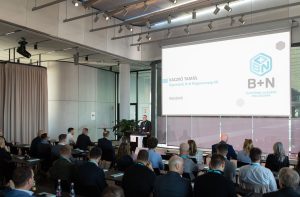
“As I walked into this company on my first day years ago, it was almost enough if the cleaners simply knew which end of the mop to hold. Since then, however, a great deal has changed: technological development and evolving client expectations have pushed us to improve,” said Managing Director Tamás Kaczkó in his opening remarks.
Since then, the company has become one of the largest employers in the country and the largest facility management provider in the region, presenting employees with an unprecedented volume of tasks. He added that one of the key aims of the professional day was to share this knowledge across divisions, including insights into the work of the research and development team and the company’s expanding service portfolio.
Sustainability, Digitalisation and AI are Already Part of Everyday Life in Hungary
According to FM Director Krisztina Dedicsné Gáspár, the rapidly changing economic and technological environment, energy efficiency requirements, labour shortages, and constantly evolving customer demands are all forcing the sector to adapt and innovate. She noted that sustainability, digitalisation, and AI are already part of everyday operations in Hungary, and innovation will play an even more prominent role in the coming years.
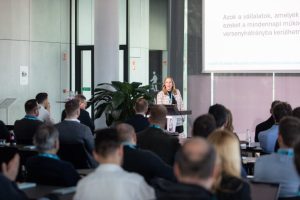
Deputy Director of SOFT FM Krisztina Domjánné Berta outlined the evolution of cleaning practices. She recalled that during the era of traditional cleaning, the goal was not only cleanliness but also a “fragrant” result, achieved through chlorine- and phosphate-based chemicals, often disregarding environmental impact. A paradigm shift began in the 1980s with gradual mechanisation and the introduction of quality assurance systems. The use of environmentally friendly cleaning agents has since made the sector more sustainable and greener, driven both by consumer expectations and climate change.
Chief Advisory Officer Csaba Szij highlighted that the global FM market is expected to grow by 30% by 2030. Alongside labour shortages, the sector will face significant challenges from rising costs and the need to meet sustainability targets. He stressed that while technological advancement and the integration of AI-based smart devices can take over many tasks, well-trained professionals will remain essential to the operation of the FM sector.
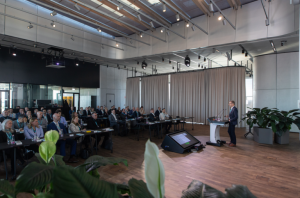
The importance of attracting and training the workforce was discussed by Szilva Papp, Head of HR Training and Development at B+N Hungary Kft. She explained that talent development must begin in vocational schools and universities, noting that the company has signed a cooperation agreement with Óbuda University as part of a scholarship programme. The company also supports disadvantaged employees through the Apponyi Franciska Future Workshop Programme, through which ten young people from challenging backgrounds have already found employment. Zsolt Kerényi, Head of Hygiene, reinforced that training and education modules must meet modern challenges, with acquired knowledge assessed through multi-stage evaluations.
ROBIN Cleaning Robots, Robotic Dogs, and Drones – and Testing Begins for Washroom Cleaning Robots
At the event, Chief Technology Officer Boldizsár Zakariás stated that the latest innovations must be integrated into everyday operations. In this regard, B+N Group has taken significant steps: according to independent international surveys (FieldBots Radar, 2025), the company operates the world’s eighth-largest fleet of cleaning robots. With more than 170 robots in operation—most deployed at client sites—they clean 5 million square metres annually.
In addition to the flagship ROBIN cleaning robots, the company also uses window- and facade-cleaning drones and machines capable of performing security tasks. From April, testing will begin on a specialised robot designed for cleaning washrooms.
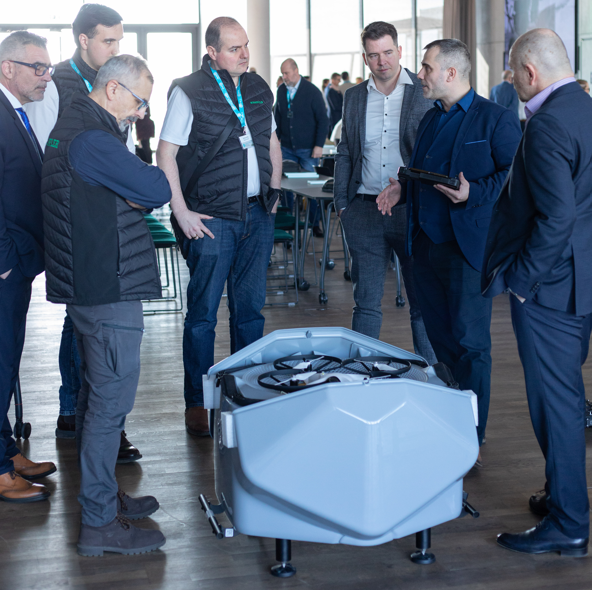
The company also deploys robotic dogs and drones for security purposes, similar to those used by police and military forces. According to Csaba Hajdu, Head of the Security Division, these devices already operate with a high degree of autonomy: they can plan patrol routes independently and detect anomalies such as damaged fences or broken windows, immediately sending alerts. Equipped with sensitive sensors, they can also detect heat, making them effective tools for fire prevention. Unlike human labour, these devices can operate in extreme conditions and are not affected by fatigue, stress, or subjective judgment. Several of these technologies were demonstrated live at the event, including a drone-based area inspection broadcast directly from Switzerland.
Sándor Kocsik, Head of the Industrial Cleaning Division, and Gergő Orovecz, Facility Manager, spoke about the importance of new technologies and their implementation in industrial cleaning. Topics included the advantages of touchless technologies, with laser cleaning helping to reduce waste generation. Chemical-free, so-called osmosis-based glass cleaning is also elevating high-rise cleaning to a new level.
On the software side of building management, Viktória Berberovics-Sóvári, project manager at BeeWise Kft., added to the well-known saying “data is the new gold”: only if we know how to use it. She emphasised that, despite many important steps forward, the FM sector still lags significantly behind in digitalisation. At B+N, the first step in the digital programme was to map and standardise operational processes through workshops. Role-based dashboards and electronic performance certifications have since become key building blocks of the company’s digital transformation.
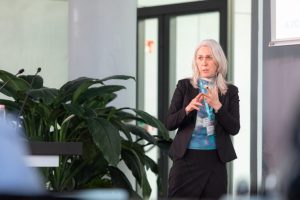
Gabriella Nagy, Head of the Horticulture Division, spoke about the importance of preserving biodiversity. Her presentation highlighted that sustainable green space management is not only essential for ecosystem management—including climate regulation—but can also be cost-effective. For example, maintaining a wildflower meadow is significantly cheaper than traditional green spaces and requires less time and energy to manage. Forested areas can be up to 10 degrees cooler, which greatly affects well-being during heatwaves. Therefore, creating wetlands and planting trees are shared responsibilities, and in everyone’s interest, she emphasised.