
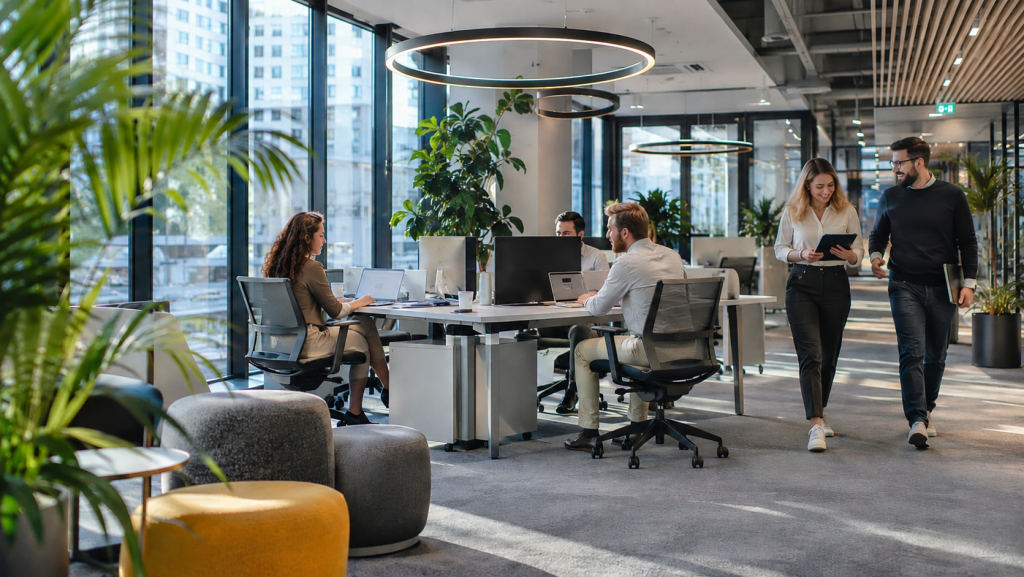
As companies encourage employees to spend more time in the office, workplace quality, flexibility and operating costs are becoming increasingly important. Landlords are under pressure to deliver buildings that offer more than just a place to work.
Employee Experience Shapes Office Decisions
Experts at SEE Property Forum 2026 in Bucharest discussed how changing workplace expectations are reshaping the office market.
Oliver Derksen, Head of Office Advisory at iO Partners Romania, noted that HR departments now play a much greater role in office selection. With more companies moving towards four or five office days per week, employee satisfaction and corporate culture are becoming central to property decisions.
However, high fit-out costs remain a major barrier to relocation, prompting landlords to offer greater financial contributions and more flexible leasing incentives.
Flexibility Becomes a Priority
Alessa Sin, Leasing Director at Mondo Development, stressed that modern offices must balance employee needs, productivity and financial efficiency.
At the company’s Nexus project, the focus is on combining workplaces with services and community spaces. A radiant ceiling system could also reduce fit-out and operating costs by approximately 20–30%, according to Sin.
Smarter Buildings, Lower Costs
Energy efficiency is another priority. At the second phase of Timpuri Noi Square, VASTINT Romania is targeting more than 100 out of 105 possible LEED Platinum points.
The development incorporates over 200 boreholes supporting heat pump systems, eliminating the need for gas-fired heating, alongside improved insulation, solar panels and other energy-saving technologies.
Antoniu Panait, Managing Director at VASTINT Romania, also highlighted the importance of openable windows, higher ceilings and cooperation between landlords and tenants to improve building performance.
Intelligent Lighting Supports Building Management
Silviu Bulzan, Sales Leader Office & Industry SEE at Signify, explained that modern lighting combined with sensors and automated controls can deliver energy savings of up to 35–40%.
Lighting represents just 2–3% of initial building investment but can account for 20–30% of electricity costs. New LED technology can also deliver payback periods of less than two years.
Beyond energy savings, intelligent lighting systems can provide occupancy data and help manage heating, cooling and ventilation.
The Future Office Must Deliver More
The discussion highlighted a clear shift in occupier priorities. Flexibility, measurable building performance and employee experience are becoming essential to office competitiveness, with landlords increasingly expected to support collaboration, wellbeing and long-term adaptability.