
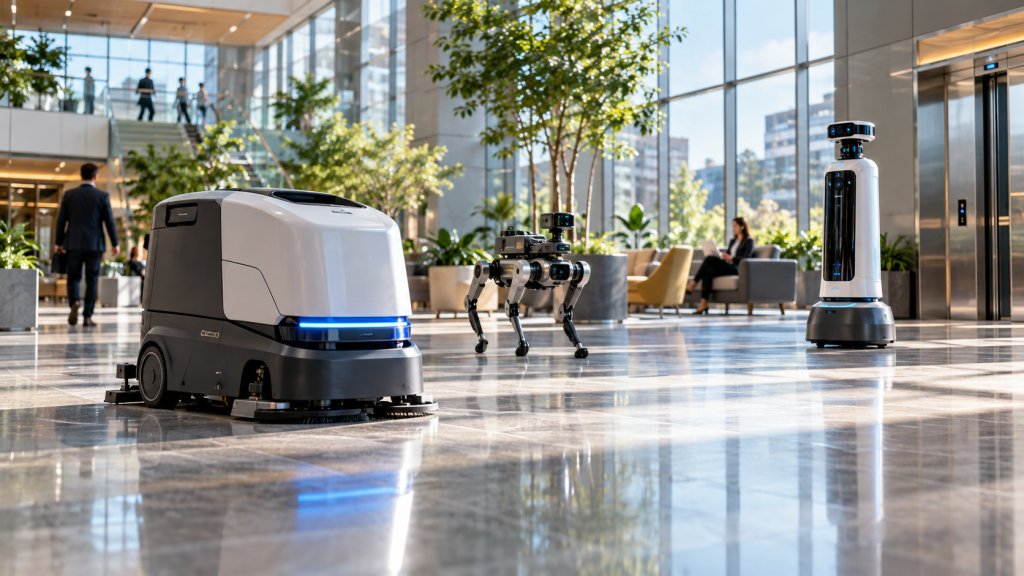
Service robots are becoming practical tools for facility management, cleaning, inspection and security. Labour shortages and advances in AI are accelerating adoption, while safety, interoperability and measurable economic value remain essential to successful deployment.
According to the International Federation of Robotics (IFR) position paper Service Robots – Impact of Robots on Human Life, published in September 2026, service robotics is moving from prototypes towards mature commercial deployment and industrialisation. Robots are increasingly used across healthcare, logistics, hospitality, retail and facility management.
Cleaning Takes the Lead
Professional cleaning is one of the most mature service robot applications. Autonomous floor-cleaning machines are already operating in airports, shopping centres, hospitals, warehouses and offices, helping organisations address labour shortages and automate repetitive, physically demanding work.
Robots can clean large, open areas while employees focus on spaces and tasks requiring greater dexterity and human judgement. They can also provide consistent cleaning quality, document results and operate during off-peak hours with limited supervision.
Robots-as-a-Service (RaaS) is established in professional cleaning and other applications. Subscription, leasing and usage-based models can reduce upfront investment and give organisations greater operational flexibility.
Beyond Cleaning
Inspection and security offer further opportunities for facility managers. Wheeled and legged robots equipped with cameras and sensors can inspect buildings, facilities and equipment, particularly where access is difficult or hazardous. Autonomous surveillance robots can also patrol large areas, detect anomalies and alert human security personnel.
AI is expanding these capabilities. Advances in computer vision, LiDAR, sensor fusion and AI-based perception allow robots to navigate changing environments and perform tasks with less programming and configuration. Multi-purpose combinations such as cleaning and delivery, or inspection and security monitoring, are also emerging, although the IFR does not expect a universal robot to replace specialised systems in the near term.
Connecting Robots With Buildings
Interoperability will become increasingly important as organisations deploy robots from different suppliers. Common interfaces and fleet-management systems can reduce integration complexity, while standards including ISO 21423 and ISO 26159 are expected to support interaction with connected building infrastructure such as lifts, automatic doors and gates.
Service robots are also increasingly integrating with operational technology, including building management systems. This connection between robots and building infrastructure will be important for scalable deployment in facility environments.
Safety, Security and People
Robots working around employees, visitors and customers need reliable obstacle detection, safe navigation and predictable behaviour. As systems become more connected and autonomous, cybersecurity, secure software updates, data privacy and governance are also important considerations.
The IFR sees service robots primarily as a way to augment human workforces. Robots can take on repetitive, hazardous and physically demanding tasks while people concentrate on work requiring judgement, problem-solving and interpersonal skills. Successful adoption therefore depends not only on technology and economic value, but also on workforce skills, training, employee involvement, change management, safety and trust.